

What Is a Surge Protector? How It Works and How to Choose One

A surge protector is a device that helps protect electronics from brief increases in electrical voltage. It limits voltage spikes by diverting excess current away from connected equipment, reducing the risk of damage to sensitive components.
That protection matters for computers, televisions, gaming consoles, and other electronics throughout a home or office. A damaging surge can cause immediate failure, while repeated smaller surges can contribute to component degradation over time.
The important distinction is that a surge protector does more than provide extra outlets. Understanding its ratings, limitations, and available formats helps you choose protection that fits your equipment rather than buying a power strip that only looks protective.
Key Takeaways
- Surge protectors limit brief voltage spikes; ordinary power strips may only add outlets.
- Most use MOVs that change resistance to divert surge current away from connected equipment.
- Compare joule rating, clamping voltage, response time, and protection-status indicators.
- Choose a UPS when you also need battery backup during outages.
Table of Contents
- What Does a Surge Protector Protect Against?
- Surge Protector vs. Power Strip vs. UPS
- How Does a Surge Protector Work?
- Which Surge Protector Ratings Matter Most?
- A Practical Checklist for Choosing Surge Protection
- Common Surge Protection Mistakes and Limitations
- The Bottom Line
What Does a Surge Protector Protect Against?
A power surge is a short-lived increase in voltage above the electrical supply’s normal operating level. Household supply voltage is typically 120 volts in the United States and 230 volts in many other countries. Connected equipment must be compatible with the local supply, but a surge can expose it to voltage beyond its intended operating range.
Surges can originate outside a building or within its electrical system. Common causes include:
- Lightning-related electrical disturbances. These can introduce powerful voltage spikes into electrical systems.
- Power-grid disturbances. Problems with the incoming electrical supply can affect connected equipment.
- Large appliances switching on or off. Equipment such as air conditioners and refrigerators can create electrical transients during operation.
This means surge protection is relevant even when storms are not the main concern. Everyday electrical activity can also expose electronics to brief voltage disturbances.
A surge protector’s purpose is specific: it helps limit those short spikes. Surge protection is not the same as battery backup or continuous voltage regulation. If your main concern is keeping a computer running when the electricity goes out, you need a different capability.
Surge Protector vs. Power Strip vs. UPS
Start by identifying the problem you need to solve. Extra outlets, voltage-spike protection, and backup power are separate functions, even when a single product combines them.
| Option | Primary function | Typical use | Important distinction |
|---|---|---|---|
| Ordinary power strip | Adds outlets | Connecting several devices at one location | May provide no surge protection |
| Power-strip surge protector | Adds outlets and limits voltage spikes | Desks, entertainment centers, and gaming setups | Protects equipment connected through it |
| Whole-house surge protector | Provides protection at the electrical panel | Broader protection across a home’s electrical system | Addresses surges at a different location than a plug-in strip |
| Uninterruptible power supply, or UPS | Combines battery backup with surge protection | Computers, servers, and tasks sensitive to outages | Can supply backup power when utility power fails |
When a plug-in surge protector makes sense
A power-strip surge protector is a practical option when several electronics are grouped together. For example, a television and gaming console can share a protected strip, provided the product is suitable for the connected equipment.
Do not judge protection by appearance. A long housing, multiple sockets, or an illuminated switch does not establish that a product contains surge-suppression components. Check the specifications for an explicit surge-protection claim and a joule rating. This power strip vs. surge protector comparison explains the distinction in more detail.
When whole-house protection deserves consideration
A whole-house surge protector is installed at the main electrical panel rather than between one wall outlet and a group of devices. Its purpose is to provide broader protection for appliances and electronics connected to the home’s electrical system.
It is worth considering when electrical disturbances are frequent or when protection is needed beyond a single desk or entertainment center. Panel-mounted protection can help address external surges entering through the electrical supply, including those associated with grid disturbances and lightning.
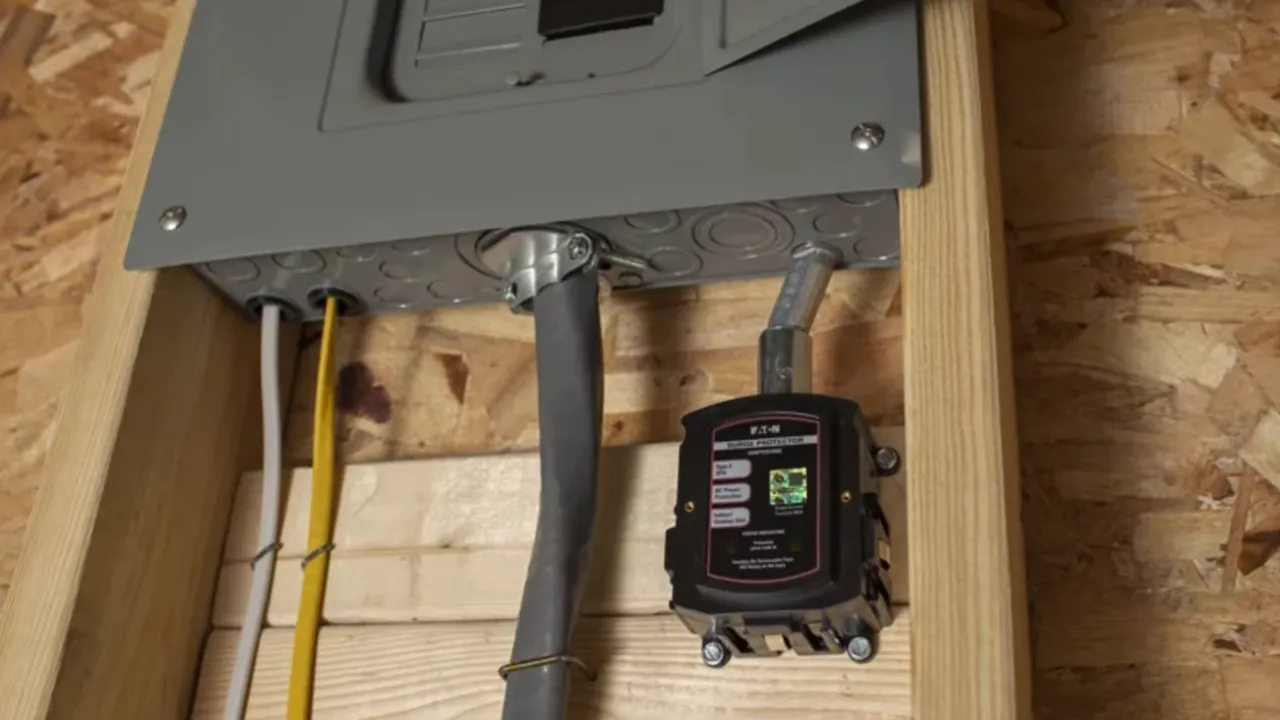
Whole-house systems generally cost more than plug-in strips. Their broader coverage is the reason to consider them, not a promise that every possible electrical event becomes harmless.
When a UPS is the better fit
A UPS adds battery backup to surge protection. That makes it useful when losing power would interrupt important work or shut down essential computing equipment.
For example, a protected power strip addresses voltage spikes at a desktop computer. A UPS addresses that concern while also providing backup power during an outage. Choose based on whether you need protection from spikes, continuity during outages, or both.
How Does a Surge Protector Work?
Most surge protectors use a component called a metal oxide varistor, abbreviated MOV. Its electrical resistance changes sharply as the voltage across it increases.
Under normal operating conditions, the MOV has high resistance and conducts very little current. It does not interfere significantly with the normal supply to your electronics.
When a voltage spike rises above its operating threshold, the MOV’s resistance drops. It then conducts surge current through an alternate path, limiting the voltage experienced by connected equipment.

The protection process in three steps
- Normal supply: Electricity powers the connected devices while the MOV remains in its high-resistance state.
- Voltage spike: The higher voltage causes the MOV to conduct, creating a path for surge current away from sensitive equipment.
- Voltage limiting: The protector limits the spike reaching connected devices while handling some of the surge’s energy.
Grounding is part of the protective path in many designs. However, the idea that a protector simply absorbs an entire surge into its housing is incomplete. Its operation involves conducting and diverting surge current as well as handling energy.
This also explains why a surge protector is not an unlimited shield. The protective components have finite energy-handling capability.
Additional components and filtering
Some surge protectors incorporate gas discharge tubes alongside other protective components. These can provide another path for conducting surge current during high-voltage events.
Other models include filters intended to reduce electrical noise. Filtering and surge suppression are related power-quality features, but they are not interchangeable. A noise filter does not, by itself, establish how much surge energy a product can handle.
Which Surge Protector Ratings Matter Most?
Once you know which format you need, compare the electrical specifications. Outlet count and USB ports affect convenience, but the protective ratings deserve attention first.
Joule rating: energy-handling capacity
The joule rating indicates the amount of surge energy a protector is rated to handle. A higher rating generally provides more energy-handling capacity, which can support longer service under surge exposure.
As a starting point for comparing plug-in surge protectors:
- Basic electronics: Consider models rated around 1,000 to 2,000 joules.
- High-end electronics or home theater equipment: Consider models rated above 3,000 joules.
These are selection guidelines, not guarantees. The equipment’s value, the electrical environment, and the protector’s other specifications still matter.
Do not confuse joules with the amount of power your devices consume. The joule rating describes surge-energy handling, not how many devices you can safely connect or how much continuous load the strip supports.
Clamping voltage: the level where voltage limiting occurs
Clamping voltage describes the voltage level associated with the protector conducting surge current and limiting a spike. When comparing otherwise comparable products intended for the same electrical system, a lower clamping voltage generally means tighter voltage limiting.
Clamping voltage and response time answer different questions. The first concerns voltage level; the second concerns how quickly the protective action occurs. A lower voltage specification should not automatically be described as a faster response.
Response time: speed of protective action
Response time describes how quickly the surge-suppression components react to a voltage spike. Faster protective action helps minimize exposure to the transient.
Consider this specification alongside energy handling and clamping performance rather than selecting a product on one number alone. A fast response does not create unlimited surge capacity.
Status indicators and practical features
A protection-status light helps you check the unit’s reported operating condition. Read the labels and instructions so you understand what each indicator means instead of assuming every illuminated light confirms surge protection.
Other useful features include USB charging ports and connected-equipment warranties. Treat USB ports as a convenience feature and review warranty terms separately from electrical performance. Neither replaces suitable surge ratings.
A Practical Checklist for Choosing Surge Protection
Use this sequence to turn the specifications into a purchase decision.
- List the equipment you want to protect. Separate a single cluster, such as a gaming setup, from appliances and electronics distributed throughout the home.
- Identify whether outages are also a problem. If equipment needs backup power, include a UPS in the comparison rather than expecting a surge strip to keep it running.
- Choose the appropriate format. Compare plug-in protection for a device group with panel-mounted protection for broader household coverage.
- Confirm actual surge protection. Read the product specifications rather than relying on the outlet arrangement or switch.
- Compare protective ratings. Review joules, clamping voltage, and response information together.
- Check everyday usability. Make sure the outlet layout accommodates your plugs and that status indicators are understandable.
- Review the instructions and warranty. Understand operating requirements, indicator meanings, and any conditions attached to equipment coverage.
For example, an entertainment center calls for attention to surge capacity and enough usable outlets for the television, console, and other components. A workstation that must remain powered during interruptions calls for a UPS. A household seeking protection for equipment across multiple rooms should consider the role of panel-mounted protection.
Protection also belongs within a safe overall setup. A suitable surge protector does not eliminate the need to inspect cords, adapters, and connections. These device charging safety checks for home and office provide a complementary inspection checklist.
Common Surge Protection Mistakes and Limitations
Assuming every power strip provides protection
This is the simplest mistake to avoid. A power strip may only distribute electricity to additional outlets. Verify that surge suppression is an actual listed function before relying on it to protect electronics.
Treating one rating as the whole story
A large joule number is useful, but it does not explain the clamping voltage, response characteristics, or operating status. Likewise, a low clamping voltage does not tell you how much energy a protector can handle. Compare the specifications as a group.
Expecting unlimited service life
Surge protection has finite energy-handling capacity. Repeated exposure or a sufficiently severe event can exhaust that capacity. The initial joule rating does not establish a fixed number of years of protection.
Pay attention to protection-status indicators and follow the manufacturer’s replacement guidance. Do not infer a universal replacement interval from the purchase date alone.
Expecting battery backup from an ordinary protector
A standard surge protector does not provide the battery function of a UPS. If your concern is an interrupted task or a computer losing power, surge suppression alone does not address that requirement.
Assuming surge protection guarantees lightning safety

Lightning-related surges are one reason to consider protection, but no selection guideline here should be read as a guarantee against every lightning event. Equipment protection and personal storm safety are separate concerns. The National Weather Service’s lightning safety guidance provides additional context for storm precautions.
The Bottom Line
A surge protector helps limit brief voltage spikes before they damage connected electronics. The right choice depends on both the equipment and the problem: a protected strip for grouped devices, panel-mounted protection for broader coverage, or a UPS when battery backup is also needed.
Verify that protection is actually included, compare the electrical ratings, and understand the product’s limits. Those steps are more useful than choosing by appearance, outlet count, or warranty size alone.
Frequently Asked Questions
Do I need a surge protector for a TV or gaming console?
Surge protection is useful for televisions and gaming consoles because voltage spikes can damage their sensitive internal components. A power-strip surge protector is a practical option when several entertainment devices are grouped together.
How many joules should a surge protector have?
Around 1,000 to 2,000 joules is a starting point for basic electronics. For high-end electronics or home theater equipment, consider ratings above 3,000 joules. Evaluate clamping voltage and other specifications as well.
Will a surge protector keep my computer running during a power outage?
No. A standard surge protector does not supply backup power. A UPS combines surge protection with a battery that can power suitable connected equipment during an outage.
Do surge protectors last forever?
No. Their protective components have finite surge-energy capacity. Check the protection-status indicator and follow the manufacturer’s instructions for evaluating and replacing the unit.
Can power surges happen without lightning?
Yes. Surges can also result from power-grid disturbances or high-powered appliances, such as refrigerators and air conditioners, switching on or off.